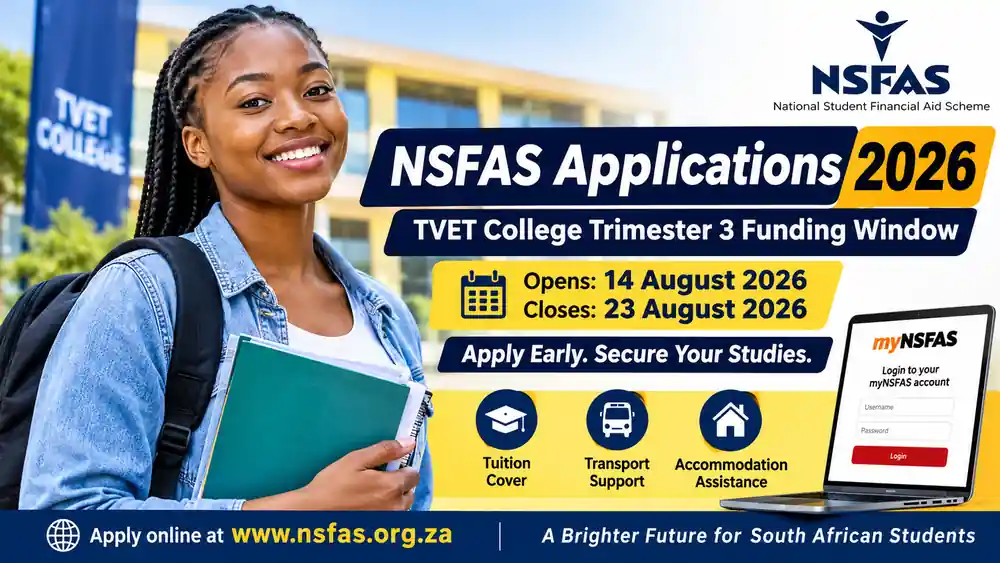
NSFAS applications 2026 for TVET College Trimester 3 open on 14 August and close on 23 August. Check funding information, requirements and how to apply.
NSFAS Applications 2026: TVET College Trimester 3 Funding Window Opens for Students
For students who are hoping to continue their studies at a public TVET college during the third trimester of 2026, the latest NSFAS applications notice is important. The application window shown in the notice provided for this article runs from 14 August 2026 to 23 August 2026, giving eligible TVET students a limited period to submit their applications.
The National Student Financial Aid Scheme (NSFAS) provides financial support to eligible students studying at public universities and TVET colleges. For TVET students, funding can cover approved study costs and, where the relevant funding conditions are met, certain allowances.
Because the application period is short, students should not wait until the final day before checking their eligibility, preparing their information and completing the application process.
Important: The 14–23 August 2026 Trimester 3 dates in this article are based on the NSFAS notice supplied for this article. Students should confirm that the application window is still open on the official NSFAS platform before submitting an application.
NSFAS Applications 2026: Key Details
| Detail | Information |
|---|---|
| Funding scheme | National Student Financial Aid Scheme (NSFAS) |
| Study sector | Public TVET colleges |
| Application cycle | Trimester 3, 2026 |
| Application opening date shown in notice | 14 August 2026 |
| Application closing date shown in notice | 23 August 2026 |
| Application platform | myNSFAS |
| Funding institution | NSFAS |
| Study period | TVET Trimester 3 |
NSFAS currently provides funding support across South Africa’s public higher education system, including universities and TVET colleges. Its official institution directory lists 50 TVET colleges and 26 universities within the NSFAS funding network.
What Are NSFAS Applications?
An NSFAS application is a request for financial assistance from students who meet the scheme’s applicable eligibility requirements.
The purpose of the funding is to reduce financial barriers that might otherwise prevent eligible students from accessing higher education and completing their studies.
For approved bursary funding, NSFAS states that funding can cover registration and tuition fees, while qualifying students may also receive allowances such as living, learning-material and personal-care support, subject to the applicable funding rules.
This is why students should treat an NSFAS application as more than a formality. An incorrect personal detail, missing information or failure to respond to a document request can affect the progress of an application.
Who Should Pay Attention to the Trimester 3 Application Window?
The notice is particularly relevant to students intending to study during the third trimester at a public TVET college.
TVET colleges use different academic cycles from universities, and engineering programmes may be offered in trimester-based study periods. A government policy document describes the third trimester for relevant engineering studies as running from September to November.
Students should therefore make sure that the programme and academic cycle they intend to enter correspond with the application they are making.
Do not assume that an NSFAS application for one academic cycle automatically covers every future registration period.
What NSFAS Says About Eligibility
NSFAS’s published 2026 information states that applicants must generally be South African citizens or permanent residents, while household-income limits and other eligibility requirements apply. The published FAQ identifies a combined gross household-income threshold of R350,000 per year, with a higher threshold of R600,000 for persons living with disabilities, subject to the applicable criteria.
Eligibility is not determined by household income alone. NSFAS also considers academic and funding rules applicable to the student’s circumstances.
This is important because meeting the income requirement does not automatically mean that funding will be approved.
What Information Should Students Have Ready?
Before starting an application, it is sensible to gather the information that NSFAS may require.
Depending on the applicant’s circumstances, supporting information can include:
- South African identity document or birth certificate
- Parent, guardian or spouse identification information where applicable
- Household income information
- Relevant supporting declarations
- Disability documentation where applicable
- Other documents requested by NSFAS during the assessment process
NSFAS states that the system generates the required supporting-document requirements according to the applicant’s circumstances.
One useful change in the published 2026 information is that NSFAS says applicants do not need to have documents certified as a general requirement.
Students should nevertheless upload clear and valid documents whenever supporting documentation is requested.
How to Complete an NSFAS Application
The basic process is straightforward, but students should take their time when entering personal information.
NSFAS describes the online process as follows:
Step 1: Visit the official NSFAS website
Start from the official NSFAS website rather than following an application link sent by an unknown person.
Step 2: Create or access your myNSFAS profile
Students who already have an account should use their existing profile where appropriate.
Step 3: Complete the required information
Enter your personal, academic and household information carefully.
Your details should correspond with your official documents. NSFAS explains that identity information is validated against Department of Home Affairs records.
Step 4: Submit the application
Check the information one final time before submitting.
NSFAS’s official application guidance summarises the process as creating a profile, completing the required information and submitting the application.
Do Not Ignore Your myNSFAS Account After Applying
Submitting an application is not necessarily the end of the process.
Students should continue checking their myNSFAS profile for notifications.
NSFAS says applicants who are asked to provide missing supporting documents should upload them through their portal. The organisation has stated that applicants notified about missing documents are given 30 days to provide the requested information. Failure to respond within the allocated period can result in the application being treated as incomplete.
This is one of the easiest parts of the process to overlook.
A student may submit an application successfully but later miss an important notification because they stop checking their account.
What If an Application Is Rejected?
A rejection does not necessarily mean that a student has no further option.
NSFAS has an appeals process for applicants who are eligible to appeal. Its published guidance states that an appeal is a request for NSFAS to reconsider a decision not to award funding, and eligible students generally have 30 days after the unsuccessful determination to appeal.
The first step is to log into the NSFAS portal and check the reason given for the unsuccessful outcome.
If an appeal is available, the student should follow the instructions provided by NSFAS and submit relevant supporting information.
NSFAS Funding Is Not the Same as Admission
This is an important distinction for students applying to TVET colleges.
An NSFAS application does not replace an application for admission to a college.
Students should make sure they have followed the relevant TVET college admission and registration process for their chosen programme. Financial aid and academic admission are related but separate processes.
A student can therefore have an NSFAS funding application while still needing to meet the college’s academic and registration requirements.
Be Careful With NSFAS Scams
The popularity of NSFAS unfortunately creates opportunities for scammers.
Students should be particularly careful when someone claims they can:
- Guarantee NSFAS funding
- Approve an application for a fee
- Change an application outcome
- Request a student’s password
- Ask for banking details through an unofficial channel
NSFAS specifically warns applicants and beneficiaries to protect their personal information and states that its officials will never ask students to share their passwords.
If somebody asks for money in exchange for supposedly securing NSFAS funding, students should be extremely cautious.
Why Applying Early Matters
A short application window can create unnecessary pressure, particularly for students who still need to find documents or resolve account problems.
Applying early gives you more time to deal with issues such as:
- Incorrect personal information
- Forgotten myNSFAS login details
- Missing supporting documents
- Difficulty uploading documents
- Questions about eligibility
- Registration or admission issues at the TVET college
It is much easier to address a problem several days before the deadline than on the final evening of the application period.
A Practical Checklist Before You Submit
Before submitting your NSFAS application, check the following:
- You are applying for the correct TVET academic cycle.
- Your personal information matches your official documents.
- You have access to your myNSFAS profile.
- Your cellphone number and email address are active.
- You have the supporting information relevant to your circumstances.
- You have checked the programme and college requirements separately.
- You have reviewed your application before submitting it.
- You will continue checking your myNSFAS account after submission.
What Students Should Remember About the 2026 Trimester 3 Window
The application notice supplied for this article identifies 14 August 2026 as the opening date and 23 August 2026 as the closing date for the Trimester 3 application window.
That means students have a relatively short period in which to act.
However, application dates can change, and NSFAS publishes updates through its official communication channels. The NSFAS website currently contains information about 2026 applications, supporting documents, funding outcomes, appeals and TVET funding.
For that reason, students should always confirm the latest status directly with NSFAS before relying on a deadline shared on another website or social-media post.
Final Word for TVET Students
For a student who has already secured a place or is working towards registration at a public TVET college, NSFAS applications can be an important part of preparing financially for the academic year.
The most useful approach is not simply to submit an application and forget about it. Keep your information accurate, monitor your myNSFAS account, respond to requests for documents and make sure you understand both the college’s registration requirements and NSFAS’s funding conditions.
The 14–23 August 2026 Trimester 3 window shown in the notice provided for this article is especially important because of its short timeframe. Students who intend to apply should verify the dates on the official NSFAS platform and avoid waiting until the closing day.
Source and verification: Information about NSFAS eligibility, supporting documents, applications, appeals and funding has been cross-checked against official NSFAS information. The Trimester 3 dates should be verified against the latest official notice before publication or application because application windows can change.
About the author: Natasha Langeni is a South African education and career-information writer. She holds a Bachelor of Arts in Information Studies from the University of Limpopo, completed in 2023, and focuses on making education, TVET, funding and career information easier for South African students and young people to understand.